Imagine a customer visiting your website for the first time.
They browse a few products, sign up for your newsletter, make a purchase, and later return for repeat orders. Now imagine guiding that customer at every step with timely emails, relevant offers, and personalized messages that match their needs.
That’s where many businesses start asking: What is lifecycle marketing, and why does it matter so much?
Lifecycle marketing is a structured approach that supports customers throughout their entire journey with your brand.
This strategy helps businesses strengthen relationships, increase customer lifetime value, improve retention, and create meaningful experiences that turn one-time buyers into long-term supporters.
In this blog, we will explore all about lifecycle marketing, its importance, key stages, and the strategies businesses use to build long-term customer relationships and sustainable growth.
What is Lifecycle Marketing?
Lifecycle marketing is a structured approach to managing and optimizing customer interactions throughout their entire journey with a brand.
It focuses on understanding how customers move from initial awareness to consideration, purchase, retention, and long-term loyalty.
Rather than treating each campaign as a separate activity, lifecycle marketing connects every interaction into a cohesive experience. It ensures that the right message is delivered at the right time, through the right channel, whether email, social media, website, or paid ads.
Unlike traditional marketing, which often concentrates on driving single transactions, lifecycle marketing emphasizes relationship building.
What are the Stages of the Lifecycle Marketing?
Imagine your business as a busy marketplace where every customer moves through different experiences with your brand. Lifecycle marketing recognises that this journey is not a single transaction but a series of connected stages.
Instead of treating marketing as isolated campaigns, it focuses on guiding customers from discovery to long-term advocacy through meaningful and timely interactions.
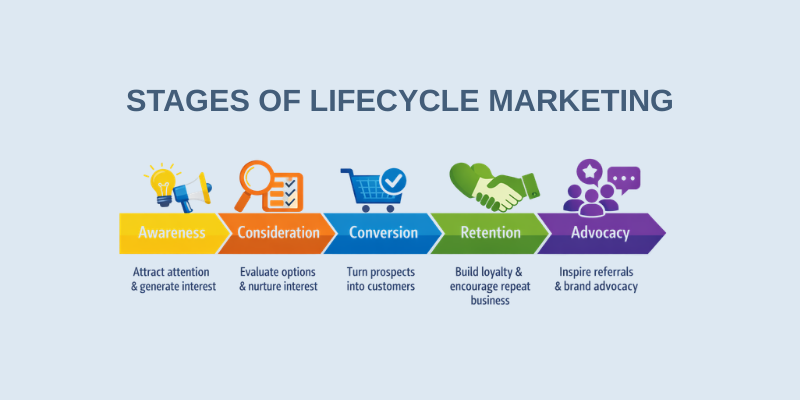
To understand this better, let’s break it into clear stages:
- Awareness: This is the stage where potential customers first discover your brand, through social media, search engines, ads, or referrals. The goal is to attract attention and generate interest. Businesses use content marketing, SEO, and targeted advertising to increase visibility and encourage exploration.
- Consideration: At this point, prospects begin evaluating your offerings. They may browse your website, read blog posts, compare products, or sign up for emails. The objective is to nurture interest by providing helpful, informative, and personalised content that builds trust and answers their questions.
- Conversion: In this stage, prospects are ready to take action, whether making a purchase, signing up, or booking a service. Marketers focus on reducing friction with seamless checkout experiences, compelling offers, retargeting ads, and clear calls-to-action that encourage confident decisions.
- Retention: After conversion, the focus shifts to maintaining the relationship. Retention strategies include post-purchase communication, loyalty programmes, customer support, and personalised engagement that encourages repeat business and strengthens brand loyalty.
- Advocacy: Satisfied customers begin recommending your brand to others through reviews, referrals, and social sharing. Encouraging user-generated content and community engagement helps expand your reach and build credibility.
Together, these stages create a continuous, connected journey that transforms new prospects into loyal brand advocates.
How Important is Data to Lifecycle Marketing?
Data is absolutely central to effective lifecycle marketing, it’s what makes the entire strategy personalized, timely, and effective rather than guesswork.
To do that, you must understand individual customer behavior, preferences, and engagement patterns. That understanding comes from data collected across touchpoints like website activity, email opens, purchase history, CRM systems, and more.
Research in digital marketing services shows that big data analytics gives businesses the ability to understand unmet customer needs, expectations, and behavior trends, insights that directly influence marketing strategy and performance.
These insights help marketers segment audiences effectively, predict future behavior, and tailor campaigns that truly resonate with customers instead of relying on assumptions.
For example, by analyzing engagement data, brands can detect early signs of churn and send retention-focused campaigns before customers disengage. This proactive approach depends entirely on accurate data.
Check Our Digital Marketing Services
What Are the Benefits of Lifecycle Marketing?
Lifecycle marketing isn’t just another buzzword, it delivers real advantages that help businesses connect with customers more effectively and grow sustainably.
Rather than focusing on one-off campaigns, this approach builds ongoing relationships with customers by engaging them at every stage of their journey.
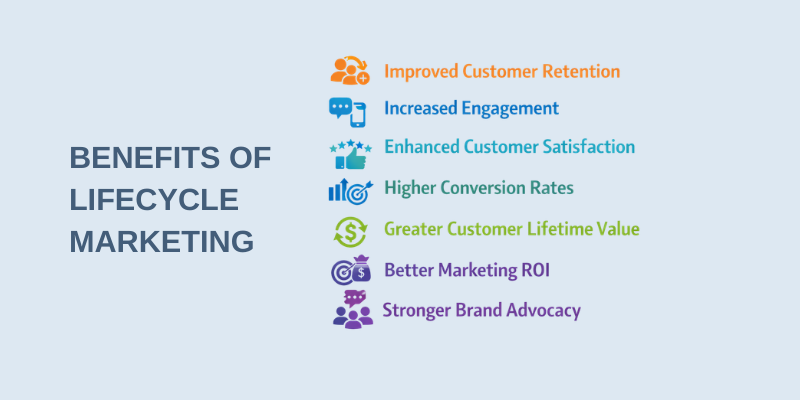
Here’s a look at the key benefits you get from implementing lifecycle marketing in your strategy:
-
Improved Customer Retention: By nurturing customers after their first purchase and keeping them engaged, businesses reduce churn and encourage repeat buying.
-
Increased Engagement: Tailored messages and personalised content keep customers interested and connected to your brand at the right time in their journey.
-
Enhanced Customer Satisfaction: Personalised communications make customers feel valued, which boosts satisfaction and strengthens loyalty.
-
Higher Conversion Rates: Targeted messaging and relevant offers help turn prospects into buyers and first-time buyers into repeat customers.
-
Greater Customer Lifetime Value (CLV): Engaged and loyal customers tend to spend more over time, increasing the total revenue each customer brings to your business.
-
Better Marketing ROI: By delivering the right message at each stage, businesses optimise their marketing spend and reduce wasted efforts on untargeted campaigns.
-
Stronger Brand Advocacy: Satisfied customers are more likely to leave positive reviews, recommend your brand, and become organic promoters, expanding your reach.
Lifecycle marketing turns random customer interactions into a strategic journey that not only improves performance metrics but also builds deeper, more meaningful connections with your audience, paving the way for long-term business success.
Your Growth Starts with a Digital Marketing Strategy
5 Lifecycle Marketing Strategies
Implementing effective lifecycle marketing strategies involves crafting personalized experiences for customers at each stage of their journey.
By understanding the customer lifecycle, businesses can tailor their engagement efforts to nurture leads, increase conversions, and build long-term relationships.
Below are some strategies to implement lifecycle marketing tactics, along with tips for engaging customers at each stage.
1. Drive Traffic and Build Interest
The goal of the Awareness Stage is to introduce your brand to potential customers. It involves sharing valuable content such as blog posts, videos, and infographics, and leveraging paid ads on platforms like Google and Facebook. Additionally, offering free resources like eBooks or white papers helps gather contact information for future engagement.

2. Provide Value and Nurture Leads
During the Consideration Stage, the focus is on providing potential customers with content that helps them make informed decisions. This can include sending targeted email marketing campaigns, offering case studies, product demos, and customer testimonials, and engaging with leads through live chat or social media.
3. Convert Leads into Customers
In the Decision Stage, the aim is to convert leads into paying customers. This can be achieved by making the buying process easy and compelling, offering limited-time deals, discounts, or exclusive offers, and using comparison charts, FAQs, or product benefits to persuade customers. A smooth checkout process is essential for ensuring conversions.
4. Keep Customers Engaged
Retention is crucial for fostering repeat business. In this stage, businesses should focus on maintaining strong relationships by implementing loyalty programs or reward systems, sending personalized follow-up emails, and providing exceptional customer service and support.
5. Turn Customers into Brand Advocates
The Advocacy Stage involves turning loyal customers into brand advocates. Encouraging customers to refer others, offering referral bonuses, and asking for reviews or testimonials helps amplify positive experiences. Recognizing and featuring loyal customers strengthens their relationship with your brand and promotes further engagement.
5 Customer Lifecycle Marketing Software and Tools
Various software tools are designed to support and optimize customer lifecycle marketing, automating key processes and enhancing customer engagement.
These tools help businesses manage, track, and analyze the customer journey, ensuring that marketing efforts are aligned with customer needs at each stage.
Here are some of the marketing tools:
1. CRM Software (e.g., Salesforce, HubSpot, Zoho CRM)
These platforms track customer interactions, segment audiences, and store detailed customer data. CRM systems allow businesses to automate personalized communication, manage customer relationships, and ensure relevant messaging throughout the lifecycle, from initial contact to retention.
2. Email Marketing Automation (e.g., Mailchimp, Klaviyo, ActiveCampaign)
These tools help businesses create automated email campaigns that are triggered based on customer actions. By sending the right message at the right time, email marketing automation enhances customer engagement and ensures timely communication throughout the customer lifecycle.
Explore Our Email Marketing services
3. Lifecycle Marketing Software (e.g., Intercom, Autopilot)
These specialized platforms focus on automating the entire customer journey. They help businesses set up workflows that engage customers at each stage of the lifecycle, from awareness to advocacy, by sending relevant messages and offers via email, chat, and more.
4. Customer Data Platforms (CDPs) (e.g., Segment, BlueConic)
CDPs consolidate customer data from various touchpoints into a unified view. This allows businesses to gain deeper insights into customer behavior, preferences, and engagement patterns. By using CDPs, businesses can tailor their lifecycle marketing strategies to deliver personalized experiences.
5. Analytics and Reporting Tools (e.g., Google Analytics, Mixpanel, Hotjar)
These tools track and analyze key metrics throughout the customer lifecycle. Businesses can use insights from these platforms to refine their marketing strategies, improve customer engagement, and measure the success of lifecycle campaigns.
FAQs
How does lifecycle marketing improve customer retention?
Lifecycle marketing improves retention by delivering relevant messages based on customer behaviour and stage. By staying connected through onboarding, engagement, and loyalty efforts, businesses reduce churn and encourage repeat purchases.
What is the difference between lifecycle marketing and traditional marketing?
Traditional marketing often focuses on acquiring customers and driving single transactions. Lifecycle marketing, however, nurtures customers throughout their entire journey, from awareness to advocacy. It prioritizes long-term relationships, personalized engagement, and sustained customer value rather than short-term sales alone.
How do you measure the success of lifecycle marketing?
Success is measured through key metrics like customer retention rate, customer lifetime value (CLV), engagement rates, conversion rates, and churn rate. Tracking these indicators helps businesses understand how effectively they are nurturing customers across each stage of the lifecycle.
What Is CRM Lifecycle Management?
CRM Lifecycle Management (Customer Relationship Management Lifecycle Management) refers to the process of managing and nurturing customer interactions throughout their entire journey with a business, from the very first point of contact all the way through to long-term loyalty and repeat engagement.
Conclusion
Now that you know what is lifecycle marketing and how it shapes the entire customer journey, it’s time to think about how you can apply it to your own business.
From the moment they first hear about your brand right through to loyalty and advocacy. Instead of focusing on one-off campaigns, lifecycle marketing guides each customer with personalised communication that matches their needs, motivations, and behaviours at every stage.
This approach is important because it helps businesses build stronger, long-term relationships rather than just chasing short-term sales.
By understanding where a customer is in their journey and delivering the right message at the right time, lifecycle marketing boosts engagement, increases customer retention, and drives higher lifetime value.
dopting lifecycle marketing strategies enables businesses to improve customer engagement, boost conversions, and create a loyal customer base.
When your marketing is tailored to the customer’s journey instead of random broadcasts, it becomes more targeted, effective, and valuable, fuelling sustained growth and long-term success. By partnering with a Centric approach, businesses can ensure a more streamlined and impactful customer experience.